
Most people think buying an asset is the end of the journey, but maximizing your real estate operations is where long-term wealth is actually engineered. At Victory Ground, we believe ownership is just the starting line—performance is what keeps you there.
In the traditional investment world, the goal is often simple: buy a property, lease it to a tenant, and wait for the market to appreciate. This is passive ownership. While this model has been the standard for decades, it contains a fundamental vulnerability: it is entirely dependent on external factors like market cycles, interest rates, and the competency of third-party tenants.
Victory Ground was built to operate differently. We believe that active real estate operations are the true engine of wealth creation. By controlling every layer of an asset—from the physical structure to the business running inside it—we move away from market-dependent returns and toward engineered asset performance.
Why Active Real Estate Operations Drive the Flywheel Effect

To understand how we drive value, we look to the “Flywheel Effect,” a concept popularized by Jim Collins in his seminal business book Good to Great. Collins argues that great companies don’t achieve success through a single “miracle moment” or one lucky break. Instead, they build momentum by relentlessly pushing a heavy flywheel in a consistent direction, turn after turn, until the weight of the wheel begins to work in their favor.
At Victory Ground, our flywheel isn’t just a list of services; it is a reinforcing loop where each component makes the next more effective:
-
- Strategic Acquisition (PropCo): We start by securing high-quality real estate in supply-constrained markets.
- Intentional Activation (OpCo): Because we own the land, we activate it with our own purpose-built businesses (like workspace or hospitality).
- Integrated Execution (Services): Because we run the businesses, we manage construction and operations in-house to ensure quality.
- Compounding Value (Performance): Because we control execution, we produce superior cash flow and returns.
- Capital Reinvestment & Compounding Expertise: This performance attracts the capital needed to acquire the next asset—and each cycle sharpens our underwriting, real estate operations, and execution. We don’t just repeat the loop; we run it smarter and faster each turn.
As Collins notes in his monograph Turning the Flywheel, the power of this architecture is that it creates an “underlying logic of momentum.” Once the wheel is spinning, the cost of growth decreases while the speed of execution increases.
Stewardship: The Core of Strategic Investment Control
We define stewardship as the disciplined responsibility to manage and improve what has been entrusted to us. While passive ownership is often marketed as “set it and forget it,” high-authority sources like Forbes suggest that this can quietly turn into “neglect as a practice.”
In a volatile economic environment, the absence of active decision-making is a decision in itself—one that often leads to underperformance. True stewardship requires what the World Economic Forum calls “long-term resilience over short-term optimization.”
At Victory Ground, stewardship means we are the “administrators” of the asset. We aren’t just waiting for a neighborhood to improve; we are actively improving the neighborhood through the businesses we build and the communities we foster. This level of investment control ensures that the asset is always being utilized for its “highest and best use”.
The Financial Power of Vertical Integration
A common trap in real estate is “value leakage.” In a fragmented model, profit often leaks out to third-party contractors, property managers, and consultants who may not have the same long-term interests as the owner.
To solve this, Victory Ground utilizes vertical integration. According to Harvard Business Review, vertical integration is a critical tool for “reducing dependency, improving execution, and aligning incentives.”
| Traditional Fragmented Model | Victory Ground Integrated Platform |
| Outsourced Management: Third parties prioritize their own margins. | Internal Operations: Our Porch Light Property Management Team prioritizes asset health. |
| Contractor Friction: Delays and cost overruns from outside trades. | In-House Trades: Our Blue Collar Construction Division ensures speed and quality. |
| Disconnected Marketing: Generic agencies that don’t know the building. | Brand Alignment: Our Huddle Marketing Team builds community from day one. |
By bringing these functions in-house, we eliminate the “middleman markup” and ensure that every dollar spent is an investment back into the property’s performance.
Asset Performance: Moving Beyond “Market Average”
Most investors are satisfied with matching a market index. However, as noted in studies on active vs. passive management, the primary benefit of an active strategy is the ability to navigate volatility.
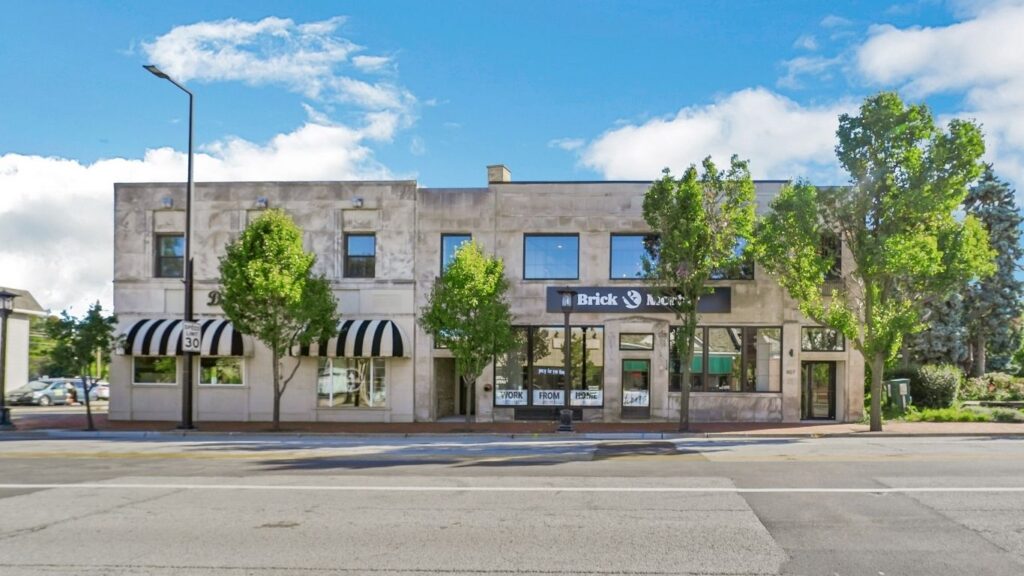
By operating the businesses inside our buildings (like Brick & Mortar workspace or The Ember hospitality), we create what we call built-in tenancy[cite: 1, 2]. We don’t have to wait for the market to bring us a tenant; we are the tenant. This internal demand generation significantly reduces vacancy risk. And allows us to “supercharge” the Net Operating Income (NOI).
Our proof of concept in Park Ridge stands as a testament to this model. By integrating real estate operations and ownership, we achieved an equity multiple of ~4.1x and an IRR of over 30%. Even while the broader market faced significant headwinds.
Key Takeaways
-
- The Flywheel Effect: Value is created through a reinforcing loop of acquisition, activation, execution, and compounding knowledge.
- Operations vs. Ownership: Real estate is the foundation. But execution via dedicated real estate operations is the driver of outsized returns.
- Stewardship: Active management and investment control prevent the “neglect” that often plagues passive investment models.
- Vertical Integration: Controlling the supply chain (construction, management, marketing) reduces costs and ensures total alignment of interest.
- Momentum: Success in one project feeds the next, creating a scalable platform rather than a series of one-off deals.
Victory Ground is not just building buildings; we are building real estate-backed businesses that scale. Over time, assets gravitate toward superior operators.
Performance isn’t assumed. It’s produced.
Ready to see our model in action?
Explore Victory Ground Investment Opportunities